Throughout my life, I have had the opportunity to serve in both leadership and management roles, including captain of the basketball team, officer candidate, member of the executive team, and CEO. In this service profession called leadership, I have sometimes succeeded and sometimes learned.
Case management (Management)
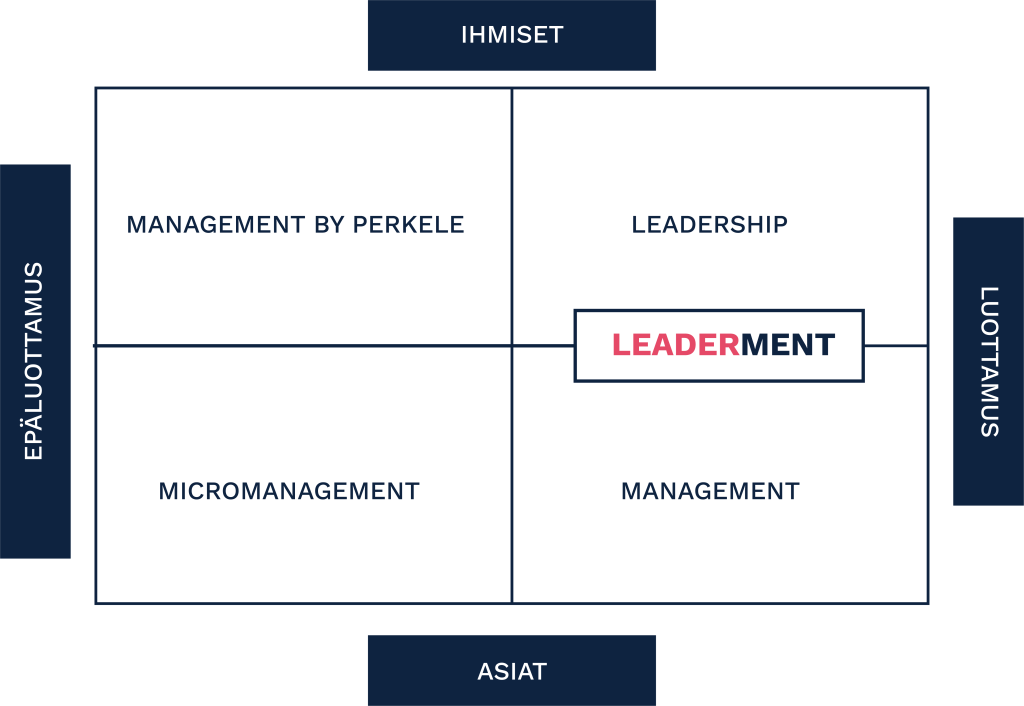
As captain of a basketball team, I trusted my team 100 %, but often my leadership was largely focused on things like the execution of offensive patterns, individual throwing or passing choices and defensive rotation. All important things, but as a matter leader you rarely light a flame in the heart called passion. In international scientific research, my management style would probably be referred to as ”management”. In Suomenniemi, it would be called management.
Micromanagement (Micromanagement)
As a recovering perfectionist and eternal optimist, I have led myself - and sometimes unwittingly others - into situations where things must be perfect and nothing is impossible. It is typical of leaders with the same character flaws as myself that in a weak moment, the urge to control rears its head. Especially if there is distrust as to whether the agreed things are happening as desired.
Most often this management style is reflected in overly detailed questions, reporting requirements or doing things for others to make sure that the desired result is achieved. As a young officer trainee, I was guilty of this all too often. In the short term, the management style may work, but in the longer term, this micromanagement creates a culture of passivity.
Management by perkele
I am happy to say that the style of leadership - where the focus is on people, but the leadership is characterised by distrust - is not one that I am self-reflectively guilty of. However, I have witnessed it a few times in my life from the role of the person being led. I will always remember how a first lieutenant, in various subordinate-manager discussions, always covered up his values and revealed them in a grandiloquent way, saying: ”we ran a meritocracy, you lost. The penalty was a 5 km run, time 25 minutes.” This kind of leadership sucks from where Marcus Grönholm's cart driver Timo hit a big pebble in the World Rally Championship of yesteryear.
”Management by the devil is characterised by hierarchical management, a constant breeding ground for mutual distrust, management by fear, inequality and the belittling of people. The ”management by devil” style of leadership, which is familiar to Finns, has been the subject of scholarly work by Timo Vuori, Professor of Strategic Management at Aalto University and one of the authors of the highly publicised Distributed Attention and Shared Emotions in the Innovation Process: How Nokia Lost the Smartphone Battle. The study shows how Nokia lost the smartphone battle because of a culture of fear within the company. Senior managers were disconnected from reality and middle management, who feared them, only provided them with information that pleased senior managers. Positional power rarely creates value and prestige.
Leadership (Leadership)
A leadership style that puts people at the centre and uses trust to drive interaction often achieves great results. In the academic world, the term ”leadership” is often used to refer to this upper quadrant of the leadership quadrilateral. In my management team and CEO roles, I have generally tended to operate in this sector. My stumbling block in leadership has sometimes been that this style of leadership alone can easily create a 'coffee-table culture' where results are sometimes secondary and difficult issues are not sufficiently discussed.
Good leadership (LeaderMent)
However, basketball and (work) life are partly both an emotional and a performance sport, at least as a leader, which is why the ideal change in leadership styles takes place in an atmosphere of trust, with people and issues in mind. As consultants, our team and I summed up this style in a catchphrase: ”LeaderMent”. Same in English: leading by trusting people and things. Below is a further visualisation of the leadership quadrilateral.
Did you have any thoughts about leadership? Contact us and let's talk more!